Things Hidden
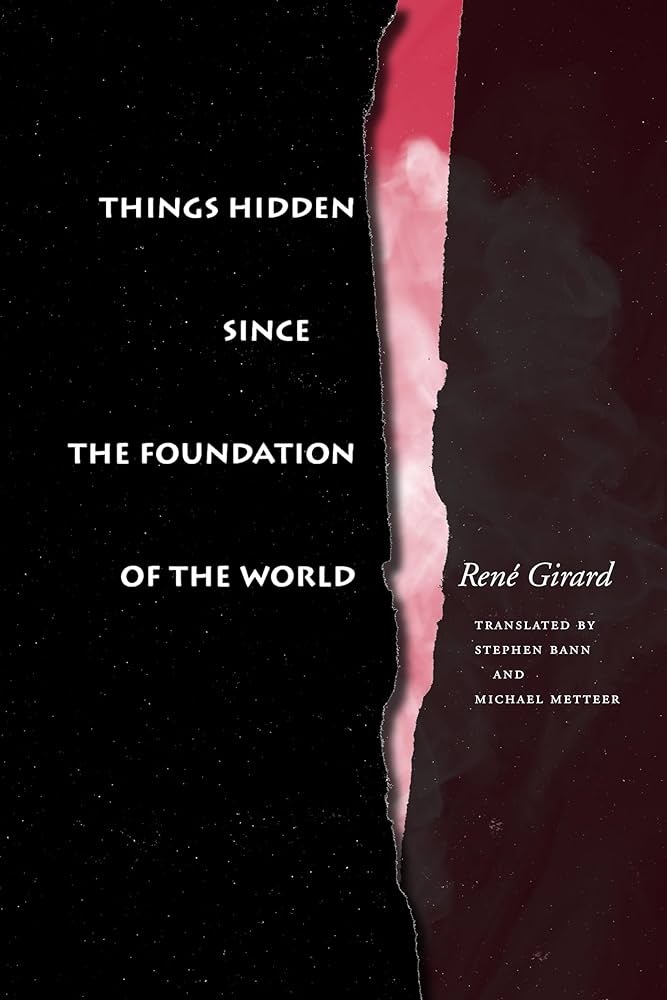
Mimetic theory of desire explains the origins of culture. It is the linchpin between the last reaches of the theory of evolution and our modern day culture. Darwin may explain how we get from a single ancestor to hominids but it does not have the capacity to tell us how we get from that first homo sapiens to the present-day human. Think cultures, traditions, economic system, religion, etc. Evolution does not explain that.
Now, mimetic theory is much more than just an explanatory “linchpin,” for it also has deep implications on religion, philosophy, and generally the nature of man. It is nuanced and any short blog on it would be a disservice to its real implications. But in lieu, maybe these quotes generate food for thought for a theory that is still largely unkown. All emphasis is mine.
R. G.: People tell us that there is no language worthy of our adherence apart from the deadly equations of science, on the one hand, and on the other a form of speech that acknowledges its own futility and ascetically denies itself the universal dimension. As for the unprecedented events that we are witnessing—the grouping of the whole of mankind into a single society, which proceeds apace—there is nothing to be said, nothing definite or even relevant. None of this is of any interest at all. We must bow down before systems of the infinitely large and the infinitely small because they can prove that their power is explosive. But there is no place for any thinking on the human scale. No one takes the trouble to reflect uncompromisingly about the enigma of a historical situation that is without precedent: the death of all cultures.
Condemning humanity to nonsense and nothingness at the very moment when they have achieved the means of annihilating everything in a blink of the eye, entrusting the future of the human habitat to individuals who now have nothing to guide them but their desires and their ‘death instincts’—all of this is not a reassuring prospect, and it speaks volumes about the incapacity of modern science and ideology to master the forces that they have placed in our hands.
R.G.: This complete scepticism, this nihilism with regard to knowledge is often put across just as dogmatically as the various dogmatisms that preceded it. Nowadays people disclaim any certain knowledge and any authority, but with a more assured and authoritarian tone than ever before.
We are getting away from one form of Puritanism, only to fall into another. It is now a matter not of depriving mankind of sexuality, but of something we need even more—meaning. Man cannot live on bread and sexuality. Present-day thought is the worst form of castration, since it is the castration of the signified. People are always on the look-out to catch their neighbours red-handed in believing something or other. We struggled against the Puritanism of our parents only to fall into a form of Puritanism far worse than theirs—a Puritanism of meaning that kills all that it touches. This Puritanism desiccates every text and spreads the most deadening boredom even in the newest situations.
The more people think that they are realizing the Utopias dreamed up by their desire—in other words, the more they embrace ideologies of liberation—the more they will in fact be working to reinforce the competitive world that is stifling them. But they do not realize their mistake; and continue to systematically confuse the type of external obstacle represented by the prohibition and the internal obstacle formed by the mimetic partner. They are like the frogs who became discontented with the King Log sent to them by Jupiter and, by importuning the gods with their cries of protest, obtained more and more satisfaction. The best method of chastising mankind is to give people all that they want on all occasions.
R. G.: It is important for us to rediscover something in which we can believe; but there must be no cheating, either with the conditions that are forced upon us by the terrible world in which we live or in terms of those that dictate that the most rigorous research must do without any form of ethnocentrism, or even any form of anthropocentrism.
What kind of thought can satisfy these necessary conditions? It cannot derive from the masters of the nineteenth century: Hegel, Marx, Nietzsche and Freud. Nor can it return to Christianity as we find it today, whether in the directly sacrificial version or in the ‘progressive’ version, which thinks it has done away with sacrifice but remains more than ever in its thrall because it has sacrificed a large part of the text to an ideal, without noticing—irony of ironies!—that this text is the only way of attaining it. Sacrificial Christianity still believes in divine thunderbolts, while its progressive double completely stifles the apocalyptic dimension and so deprives itself of the most valuable card that it has in its hands, under the flimsy pretext that the first priority is to reassure people. It is better to say nothing, in my view, of the people who take the Judaeo-Christian scriptures to be a corpse, and attempt to slow down the process of corruption by giving it massive injections of structuralized Freudo-Marxist chloroform.